Home          Back


EOTVOS JOSEF GYMNASIUM
BUDAPEST -  HUNGARY

GYMNASIUM BLATO       -         CROATIA


 Eurocamp Prižba 2001.


                                                      Ecological project :


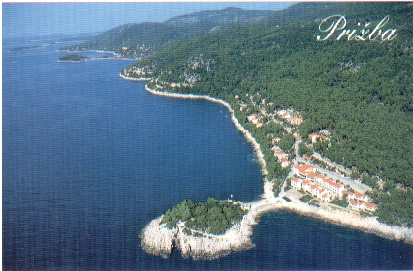
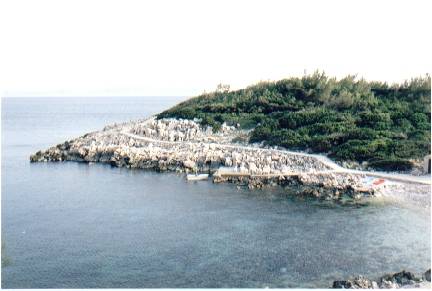
   BIOCENOSIS OF ADRIATIC SEA  -   Peninsula Prišćapac


 made by  :   Ecological group Prišćapac 01.  

                                                   BLATO,  25.05. –  02.06. 2001.


PHYSICAL-CHEMICAL CHARATERISTIC OF   ADRIATIC SEA

     During our investigation of biocenosis of Adriatic sea, we did lot of physical-chemical tests in order to find out more information about the sea around the peninsula Priscapac.

Our 1st task was to determine the temperature of air. We meansured it on two spots, A and B, in the shade and on the sun. The values were high but normal for this time of year. But for our investigation, the temperature of the sea was more important. We did the measurements on both spots and on 3 different dephts : on the surface, on 1 m deep and on 2 m deep. And this is the average temperature for spot A : 20,20C on surface, 19,50C on 1 m deep, and 19,20C on 2 m deep. There are the average results for spot B : 19,50C on surface and on 1 m deep, and 19,40C on 2 m deep. The results are expected, knowing that the summer is near ( when the temperature of the water on surface comes up to 260C ) and that temperature of air is high. The temperature is important for the whole life in the sea and it is also an indicator of termical pollution. The values we got were normal and not showing any danger of pollution.

 Our next task was measuring ph value of the sea water. We did this on spots A and B. The mean value for spot A is 7.9 and for spot B 8.1. The normal ph value of sea water is between 6.9 and 8.2 , so we are quite satisfied with the results .

       Visibility is another important factor of life in the sea because quantity of plankton and algas depends on it and it also can tell us lot about different kinds of polluting if there are any. We measured the visibility on both spots and repeated the procedure 3 times.  The mean values are visibility of 17.7 m on spot A, and visibility of 17.5 m on spot B. We expected this because the visibility in Adriatic sea is very good.

     The determing of moving of the sea was the easiest test. We just had to watch the surface of the sea and determine what is causing the movements. The cause of moving were wind and currents,

      Determing the oxygen content was our next task, but results of our measurements were not good. It was because we took the sample of water from surface and the sea was wavy. After we did the test the colour of sample was ebony and that means that there is 2-3mg O2 /dm3. This is not correct because for the life in the sea there should be at least 4mg 02/dm3. So the oxygen content must be higher because we found lot of plants and animals in the sea.

     We were not able to determine the contreutation of nitrats because we had no necessary equipment. The salinity of sea was determened with titration 0.1 mol/dm3 AgNO3. On spot A the salinity was 32%  and on spot B 34%. In the Meditteranian sea on north the salinity was 32 % and on south 38 %  . It is caused by currents.

     These were the results of our physical-chemical tests. We are quite satisfied because they show how our sea clean is, but the results could be better.

2050. 2100.
2030.


avarage

16.0

17.4     17.6

17.2   18.7

17.6  20.5

winter

8.3

9.9       10.1

9.6    11.3

10.1  13.3

spring

14.3

15.7     15.9

15.5   17.0

15.9  18.8

summer

24.4

26.0     26.2

25.7   27.4

26.2  29.4

autumn

16.9

18.3     18.7

18.1   19.9

18.5  21.9


min       max

min     max

min    max

- The table shows the incrise of the temperature in the Split region in the 21.century -
PRESENCE OF BACTERIA AROUND PRISCAPAC PENINSULA

          During our research it was necessary to determine the presence of bacteria, because they are important indicator of pollution. The research was organized in a way that we put the samples of air, sea water and soil in petries bowls, For each sample we used two bowls, one with agar + agar and one with agar + blood. We also took two samples of sea water and soil, one taken from the spot A and the other from the spot B.

          Then we put those petries bowls on the window – sill so that the bacteria could get enough warm for their growth. The last day af our staying in Priscapac we checked petries bowls. We got these results in the bowls with the samples of air, bacteria were not developed which means that the air in clean, not polluted. Only fungi grew. In the bowls with the samples of sea water two Eschericiae Coli grew but in allowable amounts ( 200/100 mL ).

           In the bowls with the samples of soil Eschericiae Coli and Protens grew as we expected. There were also fungi.Priscapac is relatively clean and preserved from pollution and  we think that it should stay as such.                                        

INVESTIGATION OF AIR, RUBBISH AND NOISE POLLUTION OF AREA OF PRISCAPAC

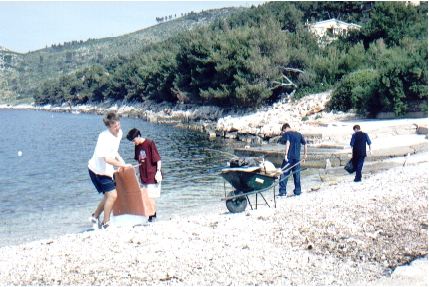
In order to establish the air pollution we hauged sheets of white paper on trees and left them there for 24 hours. After one day we took then down and examined. They were as clean as when they were first put on trees. This shows that the air is not polluted. There was also no noise pollution. We could hear only sounds of nature – birds singing and sound of wawes. But presence of rubbish was quite big. We collected it all around penninsula, we clasified and disposed it in suittable rubbish site. These are the items we found :

            36 plastic bags, 5 plastic straws, 2 plastic spoons, 28 plastic bottles, 2 plastic toys, 102 metal caps of bottles, 8 pieces of metal, 4 tins of food, 6 pieces of wire, 4 soft drinks kartons, 5 cigarette packets, 36 cigarett butts, 3 bottles, 62 pieces of broken glass, 6 pieces of wood, 3 pieces of bricks nad 1 condom. Total number of items is 314 which is definity not acceptable and we are not satisfied with this result.


COLLECTING AND DETERMING ANIMALS AND PLANTS

We succeded to collect quite lot of anima nad plant species. After that we determined them using the key books. We did not search for animals on land but we found a scelet of sea turtule (CHELONIIDAE). It could be  CARETTA CARETTA (Linne) or CHELONIA MYDAS (Linne).


  The Adriatic Sea has been used for almost 1000 years and has also been investigated for almost 400 years. Some parts of the Adriatic, actually some families of organisms have been sistematically investigated for almost 100 years.

            According to rough estimates, there are 6000 to 7000 species of plants and animals in the Adriatic Sea, but that doesn’t correspond to the real state.

Large number of species has been unsufficiently investigated. Today’s living world of the Adriatic Sea is a consequerence of various geographical, climatic and biological influences. There is a profusion of forms and colours in the sea dephts and they were created as a result of nature’s creative power.

            During these three days we came across a really heterogeneus flora and fauna in the sea around Priscapac peninsulas. We found different algae, spongia, cnidaria, bivalvia, gastropoda, echinodermata, cephalopoda, pisces, crustacea. Scientists categorized algae to PLANTAE.

However, from 1969. Whittaker and 1999. Margulis & Schwartz suggest new systematics according to which algae are categorized to the world of protocists together with protozoas and spongias.

            Algae are often an indicator of pure or polluted sea. Brown alga PHEOPHTYA grows only in the sure sea, and green alga ULVA RIGIDA is an indicator of a certain pollution in the sea.    We have found :

-         from green algae CHLOROPHYTA : Codium bursa, Codium resmilara

-         from brown algae PHAEOPHTYA : Cystoseira spinosa, Cystoseira cormiculata, Cystoseira schiffneri, Padina pavonica, Colpomenia sinuosa, Sargassum vulgare

-         from red algae RHODOPHYTA : Jania rubens, Laurentia obtusa


Only one plant lives in the Adriatic sea and that creates green fields under the sea and it is called  POSIDONIA OCEANICA.

            Animals we have found mostly live on the bottom and makes so called BENTHOS. These are :  SPONGIA ( 5000 species in the wolrd, 100 species in Adriatic ), AMERICA: CNIDARIA ( Anthozoa, Schiphozoa, Hydrozoa ).

MOLLUSCA ( 130 000 species on the world, 2000 in Adriatic Sea) :

a)    GASTROPODA – Bittium reticulatum, Cerithium vulgatum, Patella sp.

b)    BIVALVIA

c)    CEPHALOPODA – Octopus vulgaris, Eledone moschata, Sepia officinalis, Sepia elegans


POLYMERIA       ( 569 species in Adriatic Sea )

CRUSTACEA      ( 35 000 species on Earth, 1500 in Adriatic Sea )

OLIGOMERIA     - ECHINODERMATA :

a)    Luidia cilvaris, Astropecteu spinulosus, Astropecteu aranciacus

b)    Ophoderma longicaudum

c)    Echinus acutus, Arbacia lixula

 THE WHOLE IS COLLECTING GARBAGE


  MARIN AND ALMIR FOUND SOME BIG GARBAGE

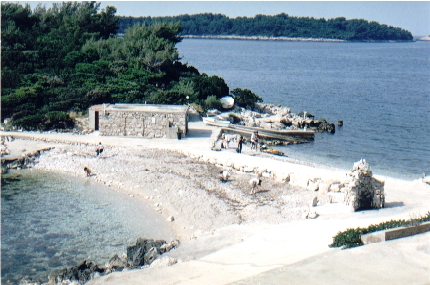
 PART OF THE BEACH


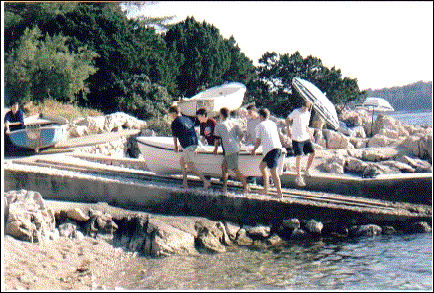
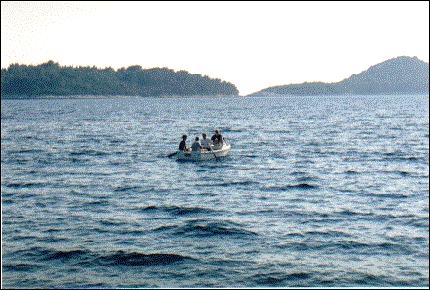
 PREPARING THE BOAT FOR LAUNCHING AND GOING TO THE SEA


 MEASURING TEMPERATURE, TRANSPARENCY, pH AND TAKING SEA SAMPLES


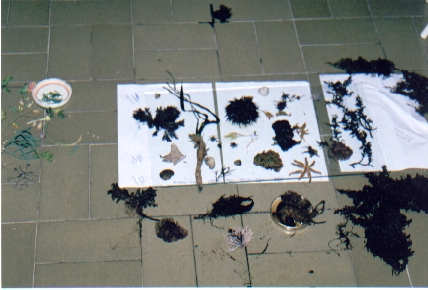
 PLANT SAMPLES AND ANIMAS BENTHOS


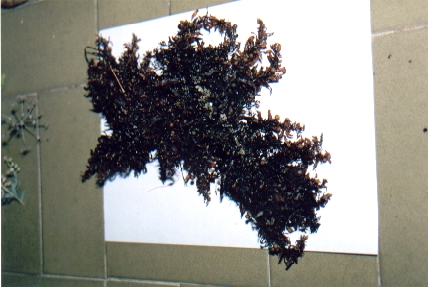
 BROWN ALGA


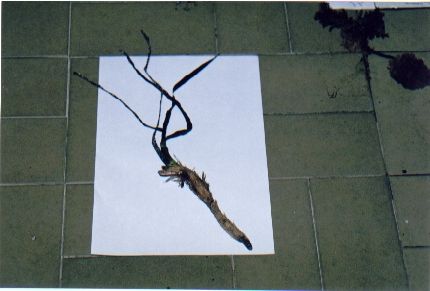
           Posedonia oceanica


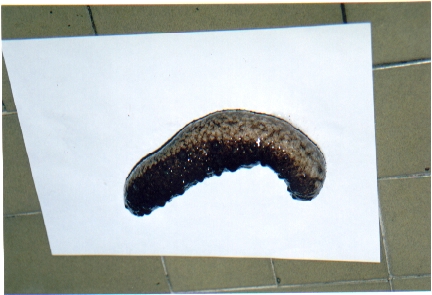
 TENDER SEA CUCUMBER


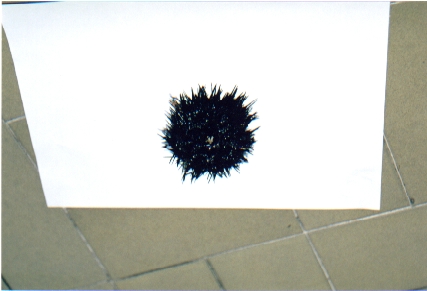
 BLACK SEA URCHIN    ARBACIA LIXULA


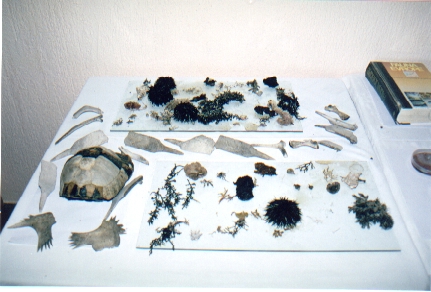
 SAMPLES ON THE PRESENTATION


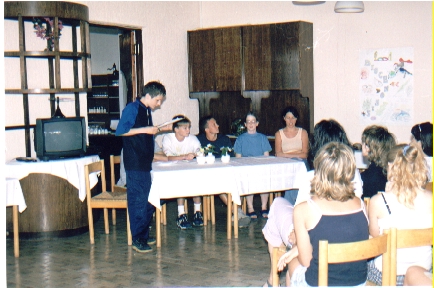
 PRESENTATION OF OUR PROJECT


made by :    DUBRAVKA CETINIĆ, prof.

                     BORKA ŠIMUNOVIĆ, prof.


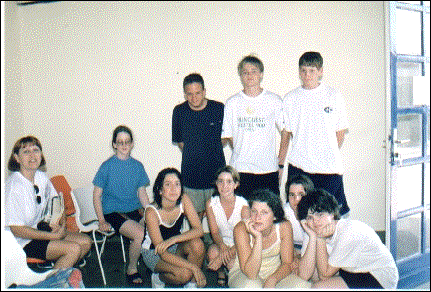
 MARIN ŽANETIĆ           PATRICIA PALFFY

                        ANA MAŠKOVIĆ                      LILLA TURIAK

                  IVAN PIROVIĆ          DORA LIPPAI

                          GABOR  SCHEILIG                                 ADAM BIRO

                  KATI SIPOS               VIKTORIA KEMENDY

      ANTE BAČIĆ              ALMIR ARNAUTOVIĆ         KAROLA KASSAI

                                GABOR MARTON


LITERATURA  :

Andrić M. :        Hrvatsko podmorje, Car Herc, Zagreb, 1999.

Šerman D. :        Živjeti s morem, Zagreb, 1991.

Domac R. :          Mala flora Hrvatske i susjednih područja, Školska knjiga,

                             Zagreb, 1975.

Gelenčir J. :        Atlas ljekovitog bilja, Prosvjeta, Zagreb, 1991.

Garms H. & Born L . :  Fauna Evrope; priručnik za određivanje, Mladinska

                                          Mladinska knjiga, Ljubljana, 1981.

Radna bilježnica iz biologije,   Školska knjiga, Zagreb, 1994.

Štambuk – Fililanovič N : Vode Dalmacije, Biblioteka Zavoda za zdravstvo

                                              Županije Splitsko – dalmatinske, Split, 1994.

Bornie D. :           Ilustrirani leksikon prirode, Mozaik knjiga, Zagreb, 1998.

Habdija J. :          Raznolikost živoga svijeta – životinjski svijet, Zagreb, 1998.

Pavletić Z . :          Raznolikost živoga svijeta – prokarioti, gljive, biljke

                               Profil, Zagreb, 1998.

Nikolić T. :            Herbarijski priručnik, Školska knjiga, Zagreb, 1996.

 Durrell G. :           Svijet prirode, Grafički zavod Hrvatske, Zagreb, 1990.

 Fabijan Grubišić :   Ribe, rakovi i školjke Jadrana, Naprijed, Zagreb, 1990.


INTRODUCTION

 During the industralization the human population grew, the manufactures and use of products also incried what wasn’t followed by the incrice of know ledge for the care and protection of nature.

That is why a change releted to the dangerous heating of the earth is needed. Taking care of the enviorment and determeting the amount of pollution is not just important for experts, scientist and ecologists, but for all people and for future generations which have the right to live in healthy condiciones.

Unfortenetly the care for the enviroment is necessary, as the determination of the pollution which is not easy, and mostly very expensive.

          The research we made from 26th to the 31th of May 2001 here on Priscapac had the goal to determine the physical, chemical and biological factors of the sea, and how do they, together with the interferince of man influence the biocenosis of the seas ecosistem,.

Our ecology group wanted to find out chemical and physical charateristic plants and animals from which we can determine the cleanes of the sea.

That is why we made and investigation of two spots that we named spot A and spot B from which we got all the information, the content of salt, the content of pollution, the temperature and the number of animals and plants life.


Home                 Back